
Three Truths and A Lie: Creating Characters that are Believable

Do you remember the game three truths and a lie? It is a group game often played to get to know one another. A person tells three truths and one lie, and the other people have to figure out what is the lie.

This game is a great example of creating believable characters. In the game people try to create truths that may appear out of character and a lie that is ordinary.

As authors we can often create truths for our characters that don’t align with the world we have created for them. I currently am struggling with one of my characters that is flat in my story. Here are a few tips that have helped me along the way.

*Character’s Journal: I have to go beyond the standard character questioner we often see, and write in their voice. Even if the story is not from their point of view, I write a scene or more in the character’s point of view.

*Motivation: Know your character’s motivation. Not only the motivation that drives them to accomplish their goals, but possible unconscious motivation that drives their personality, speech, and actions.

*Avoid Stereotypes: Most characters can be easily categorized-which is fine. Go beyond the stereotype though. Make yours unique and realistic by giving them a history, a motivation, and a voice all their own.

Delve into your inner Freud and create characters that are complex and interesting. And just for fun I added below my three truths and one lie. Feel free to join in.
  1. 3-truths-a-lieI am prepared for a zombie apocalypse.
  2. I find being underwater peaceful.
  3. I have eaten a cricket.
  4. My first pet was a five foot snake.

Brainstorming: Finding Ideas That Work

At a recent write-in, a couple of us needed to work on world building. In my case, I was working on names for magic ceremonies, events in the past, that sort of thing. One technique that worked well for us was what I call idea dumping (aka brainstorming).

I’m not talking about the old style of brainstorming: grabbing a pen and staring at a blank page for an hour until the perfect idea comes. I’m talking about dumping all the ideas out of your mind−good, bad and ugly—until you find what fits. We pulled up a thesaurus, and I wrote down everything that was said. My paper was a mess, cramped and full of notes.

I can’t lie and say magic poured out of our mouths, but as we batted around ideas they morphed into something great. So when you’re searching for that perfect name for your next goblin or handsome hunk remember a couple of things:

*Write every idea that comes to mind, even the crappy ones.

*Write at least ten if not twenty. I find my first three ideas are generic, and middle five to ten suck. The other day, it was not until at least twenty or more names had floated around until I found one I loved.

*Keep the list for a little bit, percolation helps sometimes. One writer thought she had a name, but it wasn’t until we moved on and were talking about something else did she realize the perfect one hit.

Idea Dumping can be used for book names, magic systems, upcoming plot twists, and more. Sometimes our creativity is laying on the service and other times we have to dig a little for that golden nugget.

Filling your writing toolbox with books

Many a handyman will say that without their toolbox, the work can’t be done. Writers are the same. We fill our toolbox with a variety of tools. We may pick these up at conferences, writing groups, or even blogs (wink, wink). Some of my favorite places to find those gems are books. Great writing books help me look at my writing in a whole different light.

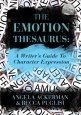
emotion-thesaurus


The Emotion Thesaurus: A Writer’s Guide to Character Expression by Angela Ackerman and Becca Puglisi. I use this book most frequently and keep it at my desk when writing. Definitely a must have. They also have several others that are worth purchasing.


James Scott Bell has so many great books on writing it was hard for me to pick only one, so I didn’t.dialogue-book

How to Write Dazzling Dialogue: The Fasted Way to Improve Any Manuscript


conflict-book


Conflict and Suspense


save-the-cat


Save The Cat! The Last Book on Screenwriting You’ll Ever Need by Black Synder. While about screenwriting, this book covers essential elements on storytelling that every author can use.


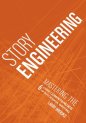
story-engineering

Story Engineering by Larry Brooks has a great comprehension books on the essential building blocks of a story.


I’m in the middle of another craft book, so this list may grow. Do you have any that I have missed? Please let me know.

Image

Riding the High of a Writers Conference

I recently went to the 30th Annual Anwa Writers’ Conference this weekend, and though my body is exhausted, my mind is filled with ideas, fueled by motivation, and warmed with a slew of new friends in the publishing world.

It took me a several years to go to a writers’ conference. I thought for sure I could learn just as much through classes and books. This weekend I realized conferences are more than the new techniques we learn (though I found some invaluable). Conferences include growing friendships in the professional writing world, and being inspired to fulfill your potential.

Where else could I casually talk to a publishing manager about my book and the current trends in the market? Or learn from New York Times Best Selling authors about craft and get to chat over lunch with them?  With some of the bigger conferences you may not get this opportunity, but you need to find what conference fits your needs.

Now that I am back home and alone in front of my computer, I’m trying to decide what is the best way to keep riding this high and fulfilling my dream. Here are some tips I thought I’d share and feel free to add some of your own.

  1. Stay in Touch: When you make connections at the conference, keep them. Friend them on social media and keep that connection if it works for you. These writers, published or not, are serious about their careers. Support each other on your journey.
  2. Utilize the Connection: If you met an agent and plan on querying them next year, make sure to remind them where you met.  And with other authors, reach out to switch reviews or beta reads.
  3. Read those Notes: We all took notes over the weekend, but don’t let your conference notes get buried in that deep drawer we never venture too.
  4. “Success is in the doing”: Don’t let those negative thoughts most writers have, get to you. We can’t wait for happiness when we get our first book deal, or make a certain list, or win a certain award. Live in the journey. Live in the writing.


Video

Digging for Characters

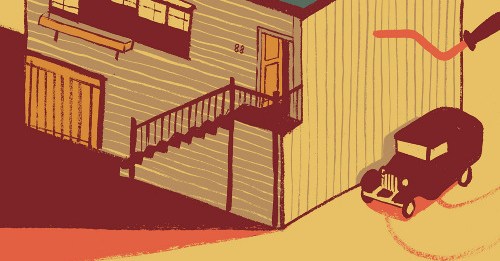
I recently read Cannery Row by John Steinbeck. I’m a fan of Steinbeck, but have to admit I struggled with the beginning of this book. It was full of description: describing places, houses, people and even a couple pages on the Model T truck. By page 34, I wasn’t sure what the plot was. Halfway through the novel, I realized how this Nobel Peace Prize Winning Author continues to draw me in—characters.

There are over two handfuls of unique, interesting characters in this book. While writing, I often want to reach for clique or average, especially in secondary characters. I want to challenge myself to dig deeper for those unique personalities that we love to read about.

Here’s an example of a secondary character, Gay, in Cannery Row that only participates for thirty five pages. While I don’t remember the color of his hair or body type, I won’t forget this story anytime soon.


Doc asked, “How are things going up at the Palace?”

Hazel ran his fingers through his dark hair and he peered into the clutter of his mind.          “Pretty good,” he said. “That fellow Gay is moving in with us I guess. His wife hits him        pretty bad. He don’t mind that when he’s awake but she waits ‘til he gets to sleep and          then hits him. He hates that. He has to wake up and beat her up and then when he goes      back to sleep she hits him again. He don’t get any rest so he’s moving in with us.”

“That’s a new one,” said Doc. “She used to swear out a warrant and put him in jail.”

“Yeah!” said Hazel. “But that was before they built the new jail in Salinas. Used to be           thirty days and Gay was pretty hot to get out, but this new jail—radio in the tank and             good bunks and the sheriff’s a nice fellow. Gay gets in there and he don’t want to come         out. He likes it so much his wife won’t get him arrested any more. So she figured out this     hitting him while he’s asleep.  It’s nerve racking, he says. And you know as good as me         —Gay never did take any pleasure beating her up. He only done it to keep his self-                respect. But he gets tired of it. I guess he’ll be with us now.”


Steinbeck paints gritty characters that stick with us. Two dimensional characters are easy, like neighbors that we wave to while our garage shuts. There is more out there, let’s tip over their trash and see who they really are. Let’s keep digging.

Feed Your Muse

I love to write. I don’t know why anyone would pick this profession for any other reason. A month ago though, the dark monsters of the swamp came out to haunt me. You know the ones with those killer claws: stress, anxiety, and insecurity.  And with writing content articles and editing my current novel, writing had morphed into some twisted self-deprecating job.

I needed a break. I needed to close my computer for a few days and feed my muse.

It was difficult at first to shut down the nagging voices telling me to be productive. But I closed my laptop, packed my bags, and escape to the country.

I went for walks. Got caught in the rain. Read for enjoyment. Mother Nature calmed my soul and left my imagination free to play.

Not everyone is not able to run away, but we still need to make time for ourselves and, as ted talksElizabeth Gilbert referred to it, Our Elusive Creative Genius.  In this TED talks, she explains that when we see our muse, or creative genius, as something outside of us, then it is easier to maintain our sanity.  It is worth the time to watch.

I enjoy thinking of my muse as a separate identity or creative genius. One we must feed and nurture in the hope that it’s won’t torment us.

How do you feed your muse?

The Brothers Grimm


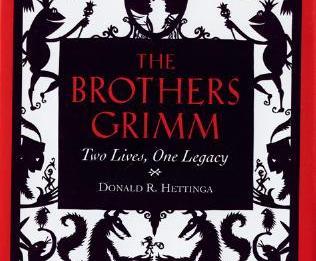
Every now and again, I like to dip into history and non-fiction. I find the change of pace welcoming and what I learn always intriguing. My most recent read was The Brothers Grimm: Two Lives, One Legacy by Donald R. Hettinga.

Jacob and Wilhem Grimm are most popular for combing the German countryside for fables and legends and publishing them. Disney has made a mint on several of their stories such as Snow White or Sleeping Beauty. But the story behind their lives was a true and interesting tale woven with kings, queens, and even revolution. The brothers Grimm preserved these ancient tales and also the German language with their books on linguistics.

My favorite part was when a critic of their first published book of stories complained that they were too graphic and disturbing for children. Jacob (the elder brother) responded that grew him up with his mother telling him the tale of How Some Children Played at Slaughtering, to show him the dangers of playing, and it worked for him. The story is about children who pretended to play slaughtering pigs and ended up killing their playmates. Fantastically morbid, I know, but part of me is still intrigued enough to read it. Wilhem Grimm’s take in response to the critics was also noteworthy: “You can fool yourself into thinking that what can be removed from a book can also be removed from real life.”

The Grimm brothers survived many political regimes and Napoleon’s conquests that sent soldiers into the streets outside their house. They dealt with poverty and death. By the end of their lives, their work and contributions were celebrated and revered. They spent their last days together, as a family.

I’ll leave you with one of my favorite quotes from the book: “In a grain of sand we may see the sense and significance of large globes of which our world is one of the smallest.” Jacob Grimm

Ten Commandments of Reading

The other day while my son was reading book four of the Michael Vay series, skipping book two and three since we’re waiting for them from our library, I decided he needed to learn some very basic rules of reading. So in my horrific English accent, I proceeded to the commandments of reading.

  The Ten Commandments of Reading

  1. Never tell the end of a good book to a friend.
  2. Read the book before the movie, except if the movie is Princess Bride.
  3. If you’re in a used bookstore, you must buy a book. Unless you’re dead broke, then go to the library.
  4. You should always have a library card.
  5. Always read a series in order, unless there are too many to keep count. Then go crazy.
  6. If a friend lends you a book and you accidentally damage it, replace it.
  7. Don’t break the binding of a book or damage a book, no matter how you detest it. Get a bookmark people, even a sock will do.
  8. If you interrupt someone during a good part of a book you must recite the alphabet backwards, while standing on your head. (Parents are the only exception for underage children, and a fire because the safety of a book comes first.)
  9. No skipping to the end of a book. Yes, you know who you are.
  10. When reciting the commandments, please use your best snooty English accent.

library card

When my daughter broke rule one as my son was reading Harry Potter, I thought she’d catch on fire with that blasphemy. And I recommend two library cards, in case of emergencies.

What is your pet peeve when reading?  Let me know. While these may be etched in stone, like every writer knows, the edits never stop.

Undiscovered Gems

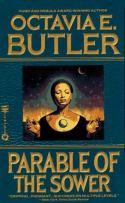
A while back, I discovered a book at the library. Published twenty years ago, this novel had a title that caught my attention: The Parable of the Sower.  I started it on a sunny afternoon, but Octavia E. Butler soon had a tight grip on me, and I kept reading late into the night.parable of the sower

This post apocalyptic novel follows a sixteen year old girl through California in 2025, amid rampant war, drugs, gangs, unemployment, and an unlawfulness that staggers the mind. The realism was nothing I’d experienced in today’s young adult commercial fiction.

This older, under appreciated book struck true and left me thinking about it for days, months, and even years later. There is joy in finding a new book or new author that speaks to you in a language that can’t be contained on paper.

I can’t wait to find my next undiscovered gem. Do you have an undiscovered or under appreciated novel hidden away in your book shelf?


2016 Writing Conferences

Spring is upon us with new anticipated books hitting the shelves (cough, cough Anne Bishop). Also, it means writing conferences starting. From April to September writers congregate to hone their craft and pitch their stories. I’ve shifted through the various conferences, and thought I’d share some reputable conferences to attend. I’d love to hear from you, if you have a favorite, and I can add it to the list.


Desert Dreams, April 7-10, 2016, Scottsdale, AZ  http://desertroserwa.org/desertdreams

The Scottsdale Romance Writers’ organization puts on a fabulous four day conference full of workshops, and pitches to agents. I know several who have attended and it comes highly recommended, especially for the price.


Las Vegas Writers’ Conference, April 28-30, 2016 http://lasvegaswritersconference.com/

I would love to hear the keynote speaker, Larry Brooks.


National Romance Writers Association Conference, July 13-16 2016, San Diego, CA

https://www.rwa.org/conference

Great conference and great location. Who doesn’t love San Diego in July?


Pikes Peak Writers’ Conference, April 15-17, 2016, Colorado Springs, CO

http://www.pikespeakwriters.com/ppwc/


And if you really feel like going all out, you can even go on a writing cruise

Out of Excuses Writing Conference, September 14-17, 2016, Caribbean

http://www.writingexcuses.com/out-of-excuses-2016/

Cruising around the Caribbean with Brandon Sanderson and a host of very accomplished writers sounds epic.