
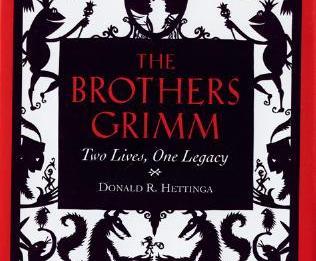
The Brothers Grimm


Every now and again, I like to dip into history and non-fiction. I find the change of pace welcoming and what I learn always intriguing. My most recent read was The Brothers Grimm: Two Lives, One Legacy by Donald R. Hettinga.

Jacob and Wilhem Grimm are most popular for combing the German countryside for fables and legends and publishing them. Disney has made a mint on several of their stories such as Snow White or Sleeping Beauty. But the story behind their lives was a true and interesting tale woven with kings, queens, and even revolution. The brothers Grimm preserved these ancient tales and also the German language with their books on linguistics.

My favorite part was when a critic of their first published book of stories complained that they were too graphic and disturbing for children. Jacob (the elder brother) responded that grew him up with his mother telling him the tale of How Some Children Played at Slaughtering, to show him the dangers of playing, and it worked for him. The story is about children who pretended to play slaughtering pigs and ended up killing their playmates. Fantastically morbid, I know, but part of me is still intrigued enough to read it. Wilhem Grimm’s take in response to the critics was also noteworthy: “You can fool yourself into thinking that what can be removed from a book can also be removed from real life.”

The Grimm brothers survived many political regimes and Napoleon’s conquests that sent soldiers into the streets outside their house. They dealt with poverty and death. By the end of their lives, their work and contributions were celebrated and revered. They spent their last days together, as a family.

I’ll leave you with one of my favorite quotes from the book: “In a grain of sand we may see the sense and significance of large globes of which our world is one of the smallest.” Jacob Grimm


Ten Commandments of Reading

The other day while my son was reading book four of the Michael Vay series, skipping book two and three since we’re waiting for them from our library, I decided he needed to learn some very basic rules of reading. So in my horrific English accent, I proceeded to the commandments of reading.

  The Ten Commandments of Reading

  1. Never tell the end of a good book to a friend.
  2. Read the book before the movie, except if the movie is Princess Bride.
  3. If you’re in a used bookstore, you must buy a book. Unless you’re dead broke, then go to the library.
  4. You should always have a library card.
  5. Always read a series in order, unless there are too many to keep count. Then go crazy.
  6. If a friend lends you a book and you accidentally damage it, replace it.
  7. Don’t break the binding of a book or damage a book, no matter how you detest it. Get a bookmark people, even a sock will do.
  8. If you interrupt someone during a good part of a book you must recite the alphabet backwards, while standing on your head. (Parents are the only exception for underage children, and a fire because the safety of a book comes first.)
  9. No skipping to the end of a book. Yes, you know who you are.
  10. When reciting the commandments, please use your best snooty English accent.

library card

When my daughter broke rule one as my son was reading Harry Potter, I thought she’d catch on fire with that blasphemy. And I recommend two library cards, in case of emergencies.

What is your pet peeve when reading?  Let me know. While these may be etched in stone, like every writer knows, the edits never stop.

Old School Dystopia

I love how dystopia has taken off lately. I devoured Hunger Games with everyone else and recently watched the fourth movie in the theaters. Suzanne Collins told of pain, love, and war masterfully, and of Katniss’s antagonist, the government.

I recently went back to some of the old school dystopian stories that I loved. And reading them a second time, helped me appreciate not only the story but the artistry involved in every word. I couldn’t help but mark up Fahrenheit 451 and pause in awe several times. 1984 left me with the haunting images that I’ll never forget. Another one off the beaten path I found was The Gate to Women’s Country by Sheri S. Tepper. There were secrets unseen that left my mind reeling for days.

Enjoying the revival of this genre makes me appreciate the classics all the more. I’ll leave you with one of my favorite quotes from Ray Bradbury.

“Stuff your eyes with wonder… live as if you’d drop dead in 10 seconds. See the world. It’s more fantastic than any dream made or paid for in factories. Ask no guarantees, ask for no security, there were never such an animal.”

Foggy Arizona

I live in sunny Arizona, but this morning I woke to this. foggy mesa

I love the eerie feel of fog blanketing the parks and shadowing the streets. Such a minor setting element can change the feel of a town, a house or a create a  whole character itself. One example of a great spectral setting is from my current book, The Darkest Part of the Forest by Holly Black. The forest in Fairfold comes alive with monsters, animals, and deadly fairies. It is the perfect read for a foggy morning, snuggled in with a warm drink.

Darkest Part of the Forest